Why Heat Treat Leaders Choose Belt Furnace Systems
Manufacturing engineers and plant managers select Surface® Combustion’s belt furnaces for compelling operational advantages:
Belt furnace systems increase heat treating capabilities step by step, allowing systematic planning for future demands. A full line of companion equipment enables building a complete, more profitable heat treating facility. Belt furnaces can be configured in straight-line or “U” shape layouts to optimize floor space utilization and material flow. Traditional and boost diffuse carburizing—where zone separation is necessary for different process step temperatures or carbon potentials—can be performed in this type of furnace.
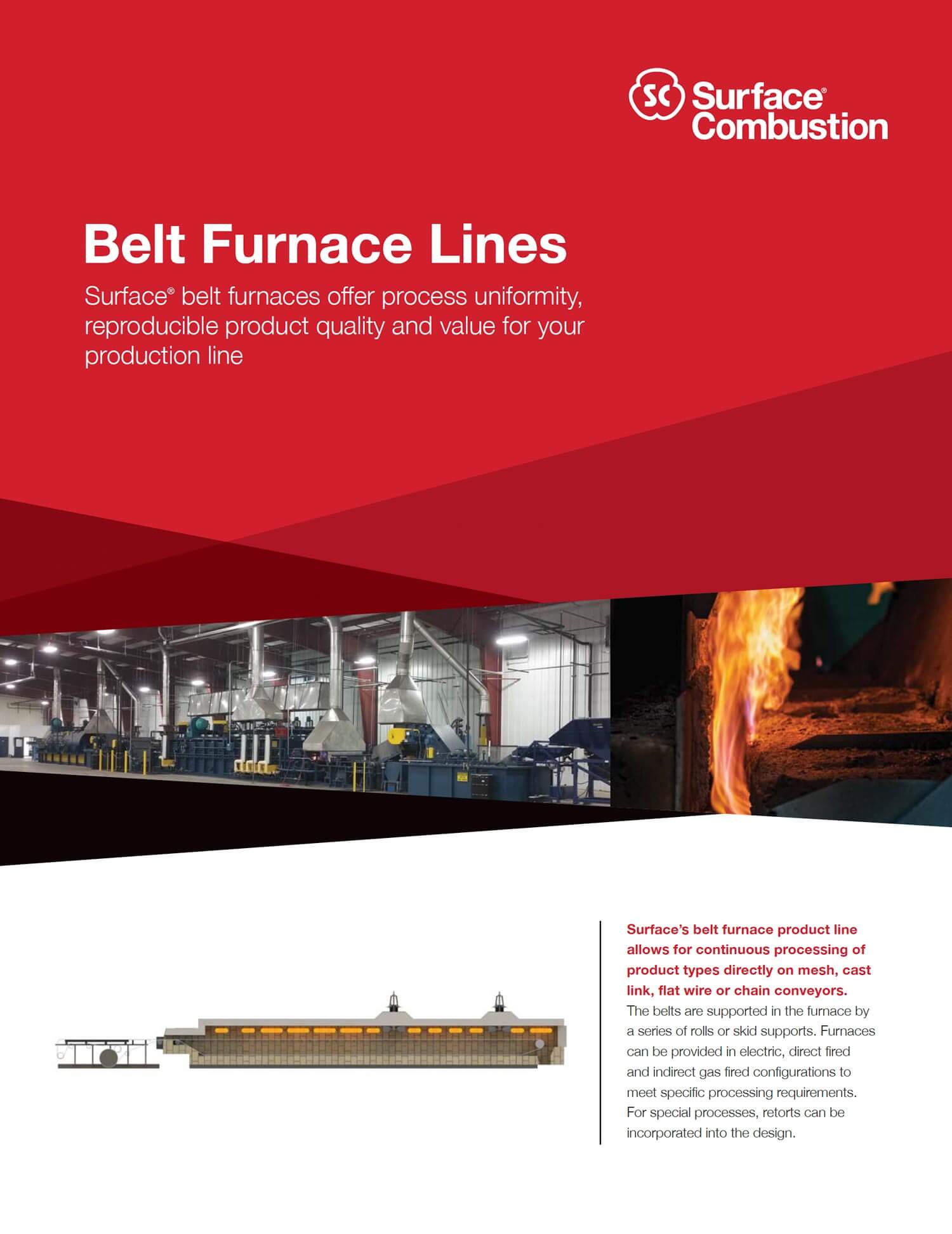
Surface chooses construction materials to maximize uptime and minimize maintenance, with sturdier steel, thicker insulation, and heavier duty components including high-quality alloy conveyance systems and robust heating systems designed for long manufacturing campaigns. The furnace belts are roll or skid supported (top and bottom) depending on operating temperature, belt type, loading, and parts processed. Belt drives are electrical motor driven via drive drums or drive sprockets ensuring dependable continuous operation. Belt returns for higher temperature models are within the furnace for better fuel efficiency.
Continuous belts convey work directly through the furnace at uniform speed with accurate time-cycle control, ensuring process uniformity and reproducible product quality throughout high-volume production runs. For those products requiring an internal atmosphere, indirect gas firing and electric heating provide precise atmospheric control. Endothermic (RX®) gas forms the base gas necessary for through hardening or carburizing. Process atmosphere choices include nitrogen, endothermic (RX®), exothermic (DX®), air, nitrogen/methanol, products of combustion, nitrogen/hydrogen, or dissociated ammonia.
Belt furnace systems are optimized to match required production rates to yield the lowest cost of processing consistent, high-quality work. Recuperated combustion systems provide energy savings while advanced controls monitor fuel consumption, atmosphere usage, component production rates, and overall furnace utilization to achieve maximum efficiency. Ceramic fiber or brick insulating systems provide excellent thermal efficiency and low energy consumption. The heating source can be direct or indirect gas fired or electric elements, with electric, direct gas-fired (recuperative and regenerative), and radiant tube systems available to meet specific energy and process requirements.
With over 100 years of history in thermal processing, many Surface belt furnace systems built over half a century ago are still in operation today. Surface Combustion’s aftermarket parts inventory and service team ensure decades of productive operation with rapid access to replacement components and expert technical support. Surface maintains one of the industry’s largest spare parts inventories with easy maintenance access.
From initial process development through equipment commissioning and lifetime support, Surface Combustion provides the expertise to maximize your heat treatment capabilities.
Learn more about the full capabilities of our Surface Belt Furnace Systems
Metallurgical Excellence Through Multiple Heat Treating Processes
Belt furnaces excel in diverse thermal processing applications:
- Carburizing
- Carbonitriding
- Through Hardening
- Neutral Hardening
- Carbon Restoration
- Normalizing
- Annealing
- Spheroidizing
- Stress Relieving
- Tempering
- Austempering
- Reheating for Press Quench
- Forging
- Sintering
- Brazing
Production Efficiency Through Advanced Technology
“Flat-surface” belt furnaces may have cast alloy links, slats, or woven mesh. “Broken-surface” belt furnaces have troughs, flights, or channels to support and convey work through the furnace.
Belt furnaces are available with electric, direct gas-fired (recuperative and regenerative), and radiant tube heating systems. Maximum operating temperatures up to 2200°F accommodate a wide range of thermal processes.
Surface’s proprietary VF™ fan extends fan life by minimizing vibration and provides uniform atmosphere distribution throughout the heating chamber, ensuring consistent results across all processed components.
Belt furnace lines can be configured in straight-line or “U” shape layouts to optimize floor space utilization and material flow. Systems can start with basic configurations and expand systematically as production demands increase.
Straight-Line

“U” Shape

Learn more about integrating automation into belt furnaces HERE.
Typical Furnace Line Equipment
Vibration and ram-type designs with a wide range of customization available.
Designed to match furnace capacity to prepare components for treatment.
Gas or electrically heated units can be paired with atmosphere generators for controlled atmosphere processing, “Flat-surface” or “broken-surface” belts provide a moving hearth that transports work through the furnace.
Designed to match furnace capacity for oil, polymer, caustic, high temperature salt or water quench mediums.
Designed to match furnace capacity to remove residue left behind after quenching.
Surface offers a variety of gas-fired or electrically heated mesh, cast and carrier, belts design to match processing capacities.
Designed to match furnace capacity to apply rust preventative coating to the parts.

Control Systems and Instrumentation
Surface offers a full line of process control systems from basic single loop controls to advanced Supervisory Control And Data Acquisition (SCADA) systems. The control systems are fully integrated with equipment safety hardware and PLC systems as required by each project.
The control system is the key to managing your furnace line for efficient production of quality product, controlling temperature, conveyor speeds, atmosphere composition, and product feed rate parameters.
Advanced SCADA Systems Offer:
- Recipe database for storing and retrieving process parameters
- Alarm database with historical tracking
- Historical trending of all key process parameters
- Part lot tracking throughout the production cycle
- Real-time part tracking through the entire process line
- Historical retrieval of part lot processing parameters including temperature, atmosphere, process times, feed rates, and any alarm conditions that occurred while processing
Controls meeting the requirements of AMS-2750 and CQI-9 can be provided as requested.
Ideal For:
Belt furnaces are ideal for high-volume continuous processing of:
- Castings
- Forgings
- Aerospace components
- Bearings
- Gears
- Fasteners
- Stampings
- Components requiring consistent, repeatable results across large production runs
Materials Processed:
Belt furnaces typically process steel, stainless steel, cast iron, aluminum, titanium, glass, powdered metal, copper, and brass components requiring precise thermal processing in controlled atmospheres.
Frequently Asked Questions About Belt Furnaces
Belt types include woven mesh furnace belts of high-grade alloy construction for lighter loaded product types, cast link furnace belts with alloy link pins for heavier loaded product types, slat conveyors for specific gears or other shapes that lend themselves to large contact area style belts, and carrier belts. “Flat-surface” belt furnaces may have cast alloy links, slats or woven mesh, while “broken-surface” belt furnaces have troughs, flights or channels to support and convey work through the furnace.
Belt furnaces are available in the following size ranges: Cast Belt Hardening with widths 24″-72″ and lengths 10′-60′ with production rates of 500-20,000 lbs/hour; Mesh Belt Hardening with widths 24″-66″ and lengths 8′-45′ with production rates of 250-7,500 lbs/hour; Belt Quenching Systems with widths 36″-84″ and production rates of 250-7,500 lbs/hour; and Mesh Belt Tempering with widths 36″-72″ and lengths 10′-50′ with production rates of 250-7,500 lbs/hour. Custom engineered sizes are available.
Belt furnaces can operate at maximum temperatures up to 2200°F. Higher temperature furnaces typically operate at 1400°F to 1950°F using radiant/conduction style heat transfer. Lower temperature styles for tempering or stress relieving operate from 350°F to 1400°F and typically incorporate convection fans.
Belt furnaces can perform annealing, austempering, brazing, carbon restoration, carbonitriding, carburizing, forging, hardening, neutral hardening, normalizing, reheating for press quench, sintering, spheroidizing, stress relieving, tempering, and through hardening. Traditional and boost diffuse carburizing—where zone separation is necessary for different process step temperatures or carbon potentials—can also be performed.
Process atmosphere choices include nitrogen, endothermic (RX®), exothermic (DX®), air, nitrogen/methanol, products of combustion, nitrogen/hydrogen, or dissociated ammonia. Quenchant options include oil, polymer, caustic, and high temperature salt. For products requiring an internal atmosphere, only indirect gas firing and electric heating may be used.
Loads can be charged and discharged by hand, gravity, robotic or other automatic mechanisms. Continuous belts convey work directly through the furnace at a uniform speed with accurate time-cycle control. Work can be bulk loaded or precisely placed for product that requires oriented loading. Racks or baskets can be used for periodic short runs. Gravity, robotic, or automatic loaders are available with vibration and ram-type designs offering a wide range of customization.
Belt furnaces are available with electric, direct gas-fired (recuperative and regenerative), and indirect gas fired (radiant tube) heating systems. For products requiring an internal atmosphere, only indirect gas firing and electric heating may be used.
Cascade quenching is used where small quantities of parts are dropped into the quench at one time. Separation of the oil from the furnace atmosphere is done via oil cascades which create a wall. Typical agitation in these style quenches are via pumps and nozzles pointed at the surface of the belt which retrieves the free falling parts and brings them up to the surface where they may be passed to a washing system prior to tempering. The oil can be heated via electric bayonet style heating elements and is cooled after quenching to return the oil temperature to the setpoint.
Surface’s extensive belt furnace line capabilities include dumpers, washers, tempers, quench tanks, and custom configurations. A typical line can include pre-washers to prepare components for treatment, quench tanks designed to match furnace capacity, draw or tempering furnaces, post-washers to remove residue after quenching, soluble oil systems for rust preventative coating, and loading cars and tables.
Surface offers a full line of process control systems from basic single loop controls to advanced Supervisory Control And Data Acquisition (SCADA) systems. Control systems are fully integrated with equipment safety hardware and PLC systems. Advanced SCADA systems offer recipe database, alarm database, historical trending of all key process parameters, part lot tracking, real-time part tracking through the entire process line, and historical retrieval of part lot processing parameters including temperature, atmosphere, process times, feed rates and any alarm conditions. Controls meeting the requirements of AMS-2750 and CQI-9 can be provided as requested.
Ceramic fiber or brick insulating systems
Maximum operating temperatures up to 2200°F
Electric, direct gas-fired (recuperative and regenerative) and radiant tube systems available
Controls meeting the requirements of AMS-2750 and CQI-9 can be provided as requested
Wide variety of belt designs
Gravity, robotic, or automatic loaders available
Roller or skid belt supports
Low energy consumption
Full line of companion equipment
Proprietary VF™ fan extends fan life by minimizing vibration and gives uniform atmosphere distribution
Annealing
Austempering
Brazing
Carbonitriding
Carburizing
Forging
Hardening
Normalizing
Reheating for Press Quench
Sintering
Stress Relieving
Temper
Partial processes list shown. Looking for something specfic, contact us.
Aerospace
Agricultural
Automotive
Bearings
Commercial Heat Treating
Fasteners
Gears
Hand & Power Tools
Off Road/Mining/Excavation
Powder Metals
Partial industries list shown. Looking for something specfic, contact us.
Aerospace Components
Aluminum
Bearings
Brass
Cast Iron
Casting
Chain
Copper
Fasteners
Forgings
Gears
Glass
Powdered Metal
Stainless Steels
Stampings
Steel
Titanium
Partial material and component list shown. Looking for something specfic, contact us.
Partial companion equipment list shown. Looking for something specfic, contact us.
Related Links:
Surface® is Your Source
CONTACT US TODAY, and let us show you the Value of Surface™
